The Space Pen and the Moonwatch: Two technologies of the space race, two different markets
The famous story that NASA spent millions inventing a pen for space is largely a myth. Yet the underlying lesson may still hold. The engineering problem was real and solved, but the initial market for that solution turned out to be surprisingly small.

The story that NASA spent millions developing a pen that could write in space is widely repeated. While American engineers supposedly built a sophisticated “space pen”, the story goes, Soviet cosmonauts simply used pencils.
The anecdote is often told as a lesson about avoiding overengineered solutions to simple problems. In reality, it is largely a myth.
The engineering problem was real, and the Space Pen solved it. But when viewed alongside other Apollo-era objects, the story hints at an unexpected insight: it may be wrong about the engineering, but not entirely wrong about markets.
Even when a technical solution works perfectly, the market for that solution may still be surprisingly small.
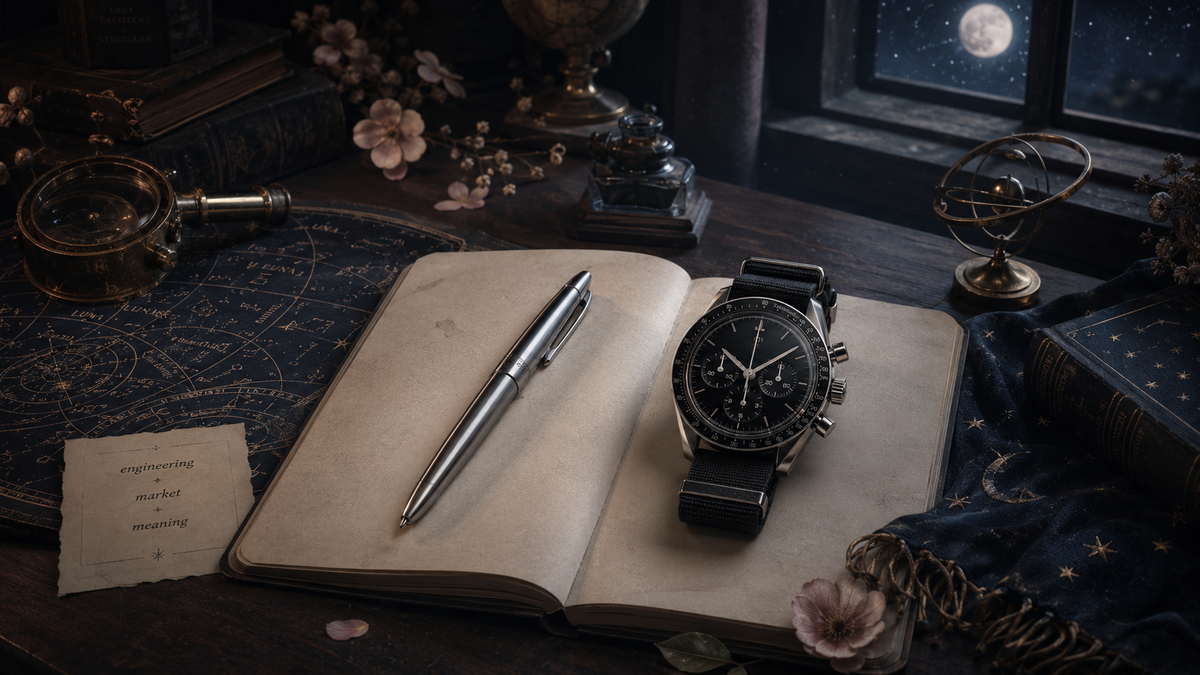
Both the Fisher Space Pen and the Omega Speedmaster were associated with the Apollo missions. The Space Pen solved a safety problem inside spacecraft, while the Speedmaster entered a large consumer market where the Moon landing gave the watch cultural meaning.
What actually happened: the problem the Space Pen solved
The challenge was writing safely inside spacecraft.
Ordinary ballpoint pens can write unreliably in zero gravity because ink does not consistently reach the tip. Pencils work in weightlessness and were used in early missions, but they pose risks inside spacecraft. Graphite dust can float through the cabin and interfere with electronics, and wooden fragments may present fire hazards.
According to Scientific American and Fisher Space Pen Company archives, in the mid-1960s Paul C. Fisher, founder of the Fisher Pen Company, invested roughly US$1 million to develop a pressurised ballpoint cartridge.
The development risk was private. The familiar story of government engineers spending millions developing a pen for space is therefore misleading.
Fisher’s design used a pressurised ink cartridge filled with thixotropic ink:
- The cartridge is sealed and pressurised with nitrogen gas, which pushes ink toward the ballpoint.
- The ink remains thick when still but becomes fluid when writing, similar to mascara or paint.
Together these features allow the pen to write in zero gravity and across a wide temperature range.
A $1 million experiment and a $1,180 order
Technically, the solution worked well. Fisher offered the pen to NASA for testing. After evaluation, NASA adopted the design for Apollo missions in 1967, and the Soviet space programme later purchased the same model.
Financially, the early economics were unusual. The development cost far exceeded the size of the initial market. Although Fisher invested roughly US$1 million to develop the pressurised cartridge, NASA’s first purchase in 1967 was modest: about 400 pens at roughly US$2.95 each, worth just over US$1,000 in total.
Today the Fisher Space Pen Company sells more than one million pens annually worldwide. The invention eventually became a sustainable business, though the market remains relatively specialised. The technology later found uses in aviation, military fieldwork, outdoor exploration, and industrial environments where ordinary pens may fail.
None of this diminishes the engineering achievement involved. Solving reliability problems in extreme environments is difficult and valuable work. But from a business perspective, inventions also interact with the size and structure of their markets.
Another successful object from the same era
A second Apollo-era object illustrates how the same historical moment can produce a very different commercial outcome.
The Omega Speedmaster Professional was introduced in 1957 as a racing chronograph. It was not originally designed for space. After undergoing environmental tests, NASA qualified the watch for manned space missions in 1965.
Astronauts wore the Speedmaster during the Gemini and Apollo programmes, and Buzz Aldrin’s watch became the first worn on the Moon during Apollo 11.

The Speedmaster did not solve a uniquely space-specific engineering problem. It simply proved robust enough to pass NASA’s demanding tests.
Produced by Omega SA, the Speedmaster is now one of the brand’s most recognisable models and sells for several thousand dollars. The association with the Moon landing helped transform it into a lasting cultural symbol.
Part of the difference lies in the nature of the product category. A watch is not only a tool for measuring time. It can also serve as craftsmanship, jewellery, and status. The story of Apollo added another layer of meaning to something that already existed within a large consumer market.
A third example: Velcro
Another technology linked to the space programme illustrates a third outcome.
Velcro, invented in 1941 by Swiss engineer George de Mestral, uses a hook-and-loop fastening system inspired by burrs that cling to fabric. During the 1960s NASA used Velcro inside spacecraft to secure tools and equipment in zero gravity.
Unlike the Space Pen, Velcro was not invented specifically for space. But its use in astronaut equipment helped familiarise the technology with the public.
Today hook-and-loop fasteners appear in clothing, footwear, medical devices, sports equipment, and industrial products worldwide.
How markets reward inventions
These three examples illustrate different commercial paths.
The Space Pen solved a narrow reliability problem and continues to serve specialised environments where ordinary pens may fail. Velcro addressed a fastening problem with wide applications and spread across many industries. The Speedmaster entered a large consumer category where the Moon landing gave it a powerful narrative.
The myth about the Space Pen warns against complicated engineering. The anecdote turns out to be historically inaccurate, but perceptive about markets. Inventions succeed not only because they work, but because of the markets and meanings that surround them.
Sources
“Space Pens, Pencils, and How NASA Takes Notes in Space.” NASA Technology Transfer Program, 2013.
Fisher Space Pen Company. “History of the AG-7 Space Pen.” Fisher Space Pen Company.
NASA History Office. Apollo Mission Equipment Records. NASA.
Omega SA Archives. “Speedmaster Professional and NASA Qualification History.” Omega SA.
Scientific American. “Fact or Fiction: NASA Spent Millions Developing a Pen That Could Write in Space.”