What Makes It Stick?
What Apple Health, Healthy 365, Strava and a physio's app suggest about motivation and habits, and how I'm applying these to Claude artefacts for learning dance and languages.
What health and fitness apps can teach us about habits, feedback and progress.
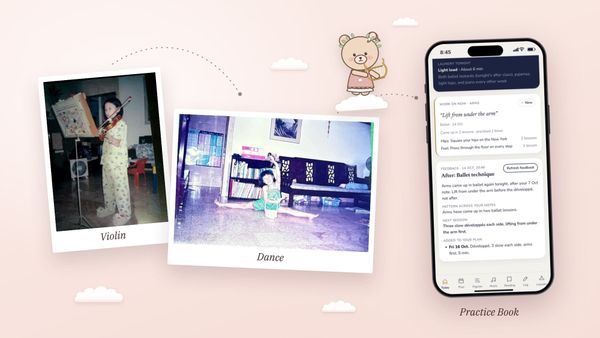
I needed a system to make progress in dance: corrections from different teachers, choreography notes, class bookings, balancing my schedule, and laundry.
I was keeping short notes after every class. So, I built a Practice Book to:
- Keep my teachers' corrections in one place
- Help me decide what to practise each day
- Let me look back at what I've done.
Building it made me look more closely at the health and fitness apps I've used, and at why I kept on using only some.
Each of the apps here has a different approach to what keeps people going: useful information, rewards, a social audience, or professional advice.
I tried to make each insight shape something in my Practice Book or, later, in Language Desk, the tool I built for languages.
What does sticking to something mean?
"Stick" can mean different behaviours and outcomes.
- An app sticks when you keep opening it.
- A habit sticks when you keep doing the activity.
- A skill sticks when practice adds up to progress.
I found a framework, the COM-B model, which suggests that behaviour depends on three things: capability, opportunity and motivation.
The model's authors also developed the Behaviour Change Wheel, which matches types of support, such as training or incentives, to encourage resulting behaviours.
Why I keep opening Apple Health
I open Apple Health nearly every day to check my sleep, my activity and the calories I've burned against what I've eaten.
My Apple Watch syncs most of it in the background. (I log my diet on MyFitnessPal.)
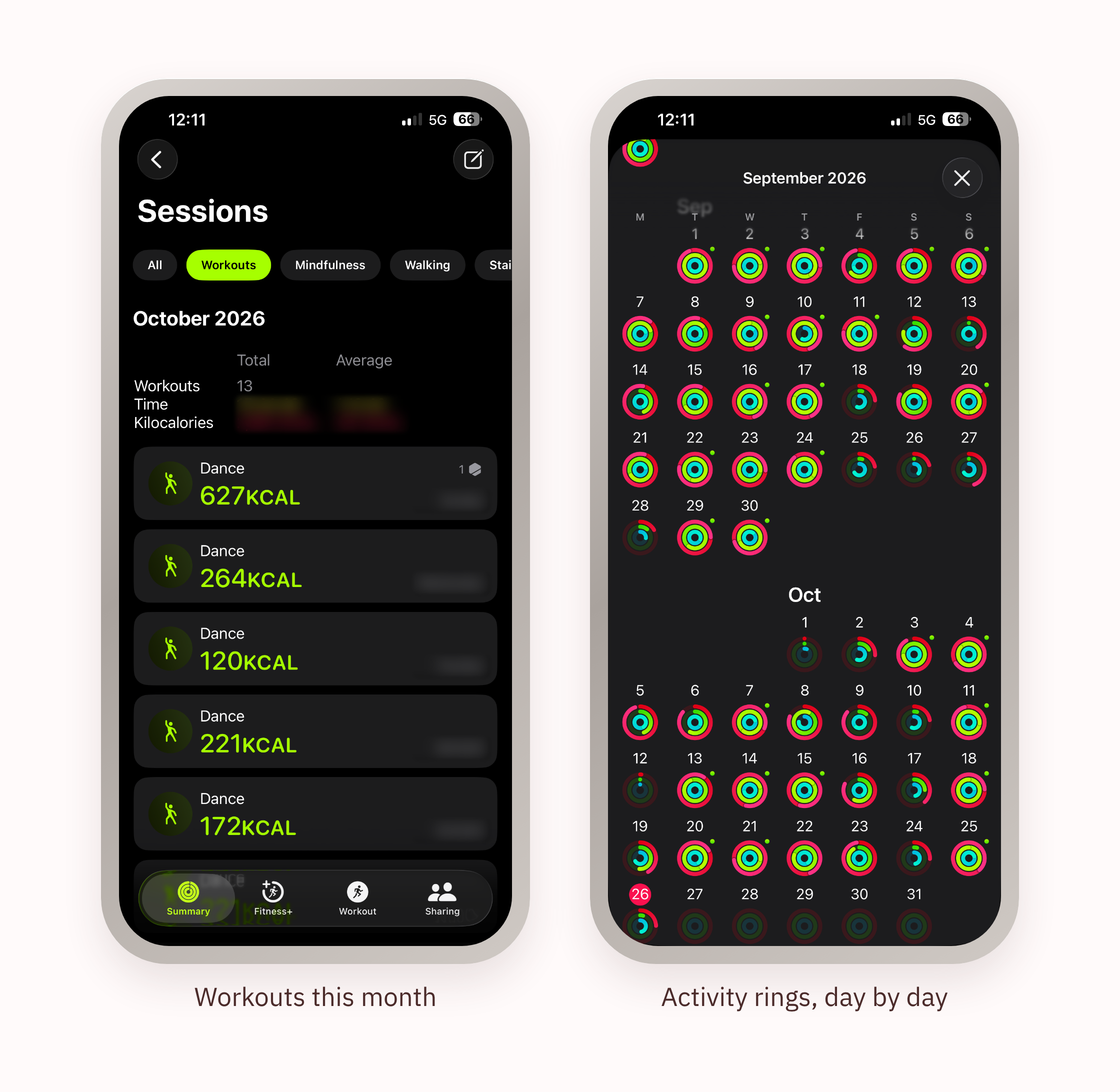
Health brings data from the watch, phone and other apps into one place, and its trends can flag longer-term changes such as a rising resting heart rate.
The watch can also flag an unusual heart rhythm and, in some regions, signs of high blood pressure or sleep apnoea.
BJ Fogg's behaviour model describes a behaviour as motivation, ability and a prompt. Health works mostly on the last two: recording takes almost no effort, and trends prompt you when something changes.
I keep using the app because I can action on my own data. I adjust what I eat based on calories in and out, and notice when my sleep has been disturbed.
So Health keeps me returning and shapes my decisions.
Can rewards change behaviour?
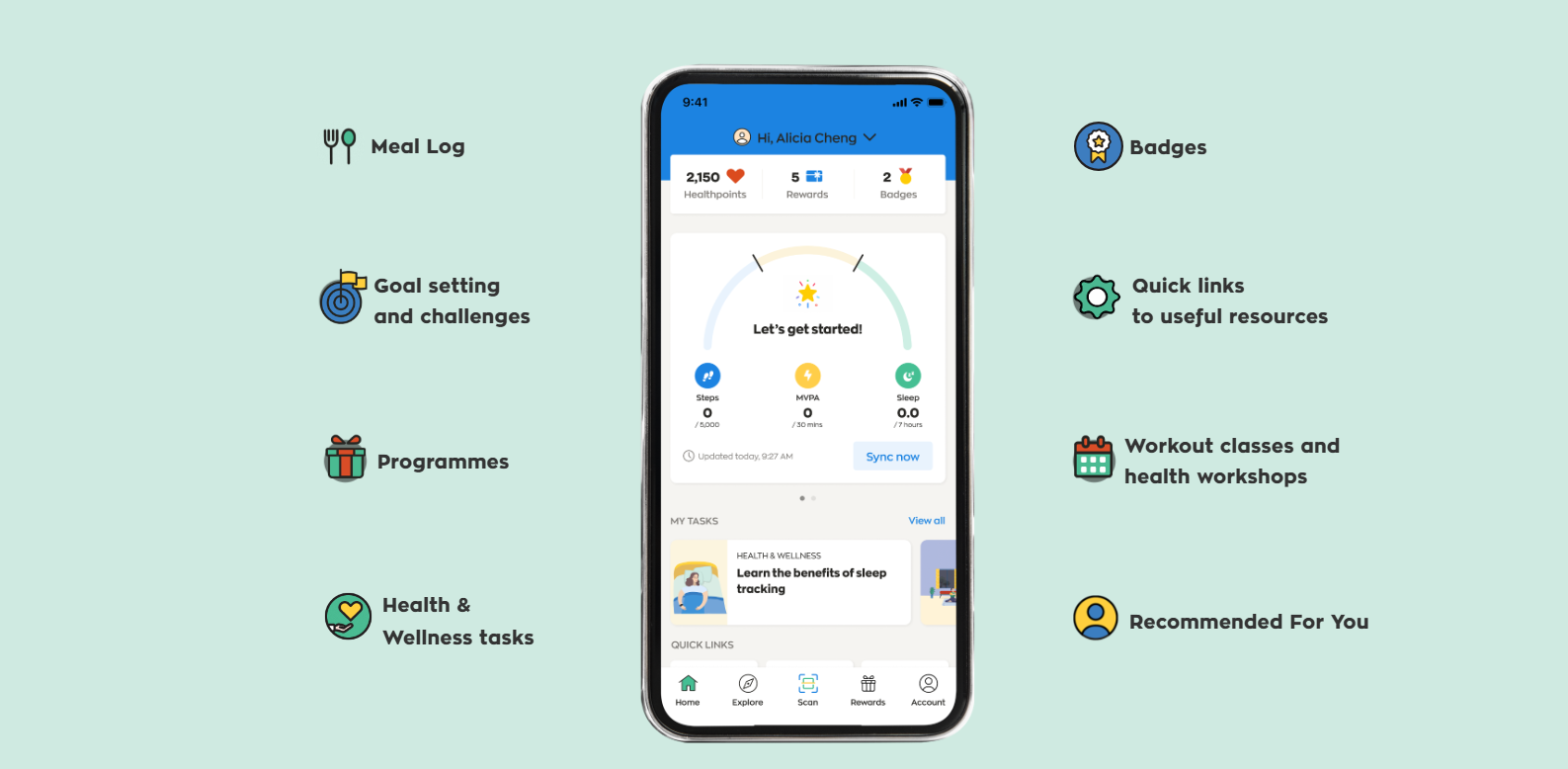
Healthy 365 rewards activity. Singapore's Health Promotion Board (HPB) runs it, turning eligible activities, such as daily steps, into Healthpoints that people can exchange for vouchers.
In February 2026, the board said about 885,000 residents, roughly a quarter of adults, use it every month.
The home screen shows daily targets for steps (5,000), moderate-to-vigorous activity (30 minutes), and sleep (seven hours), with Healthpoints, rewards, and badges along the top.
Its best-known feature is the seasonal National Steps Challenge, in which activity earns points.
During one season, a study of over 400,000 people found median daily steps rose from about 7,500 to about 10,000 during the challenge.
However, the study didn't follow these users after the challenge, so here’s info from other trials:
- Other trials elsewhere that paid people cash to walk suggest some of the increase do last for a while even after payments stop!
- In one small trial, much of the gap between paid and unpaid groups had closed seven months later.
Self-determination theory makes a point that people tend to keep going when an activity feels chosen, shows them improving and connects them with others.
I signed up for Healthy 365 mostly for the discounts, but it didn't motivate me. It did for some friends, though. What I lacked were the tools then: a smartwatch, the basic fitness to reach the daily target and some know-how to keep going.
In COM-B terms, the rewards worked on motivation, while my gaps appear to be opportunity and capability. A reward seems most likely to help someone who can already do the activity and mainly needs a nudge.
When progress becomes social
Strava works on two things: company and consistency.
In December 2025 it said it had over 180 million users, without saying how many are active. Activities appear in followers' feeds, where they can give kudos, Strava's version of a like.
In a study of over a million runners, people tended to run a bit further on days their friends ran more. Being seen may help some people keep going.
Personally, I stopped using Strava because I didn't want my route maps online. While the app has privacy settings, I'd joined for the community, and hiding my activities defeated that.
Are streaks sticky?
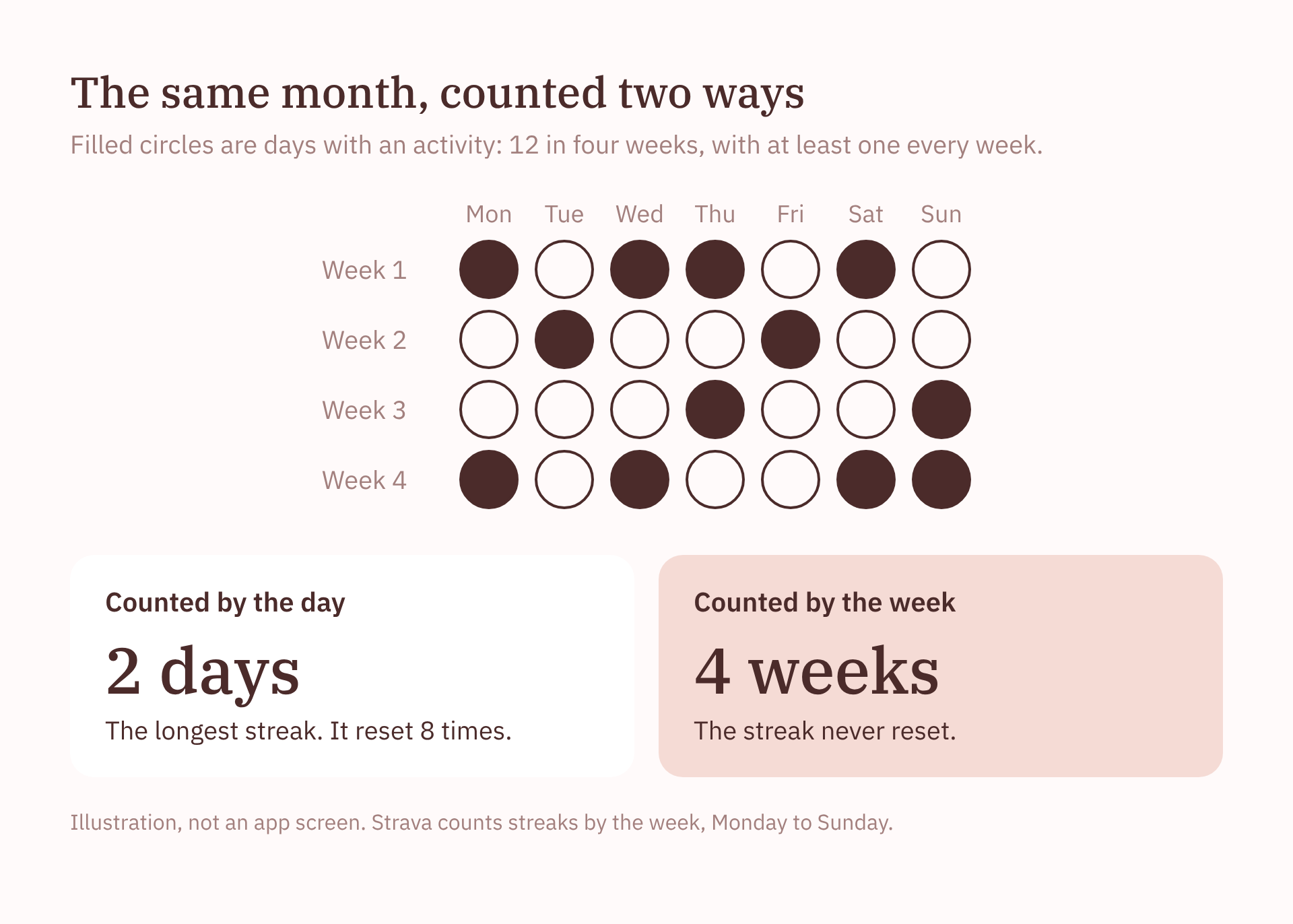
The part I might borrow is the streak, which Strava counts by the week. One activity of at least a minute between Monday and Sunday keeps it going, and an upload after the week ends still counts.
But challenges such as 75 Hard take the opposite approach. Missing a single task means restarting. Its creator, Andy Frisella, calls it a mental toughness programme, not a fitness challenge.
Experts are divided: some value the structure, while others point to injury risk and a high chance of failure.
I thought one aim was to remove the daily decision altogether:
- A no-skip rule makes each day simple. It makes skipping costly, and starting from zero after a bad day is not encouraging.
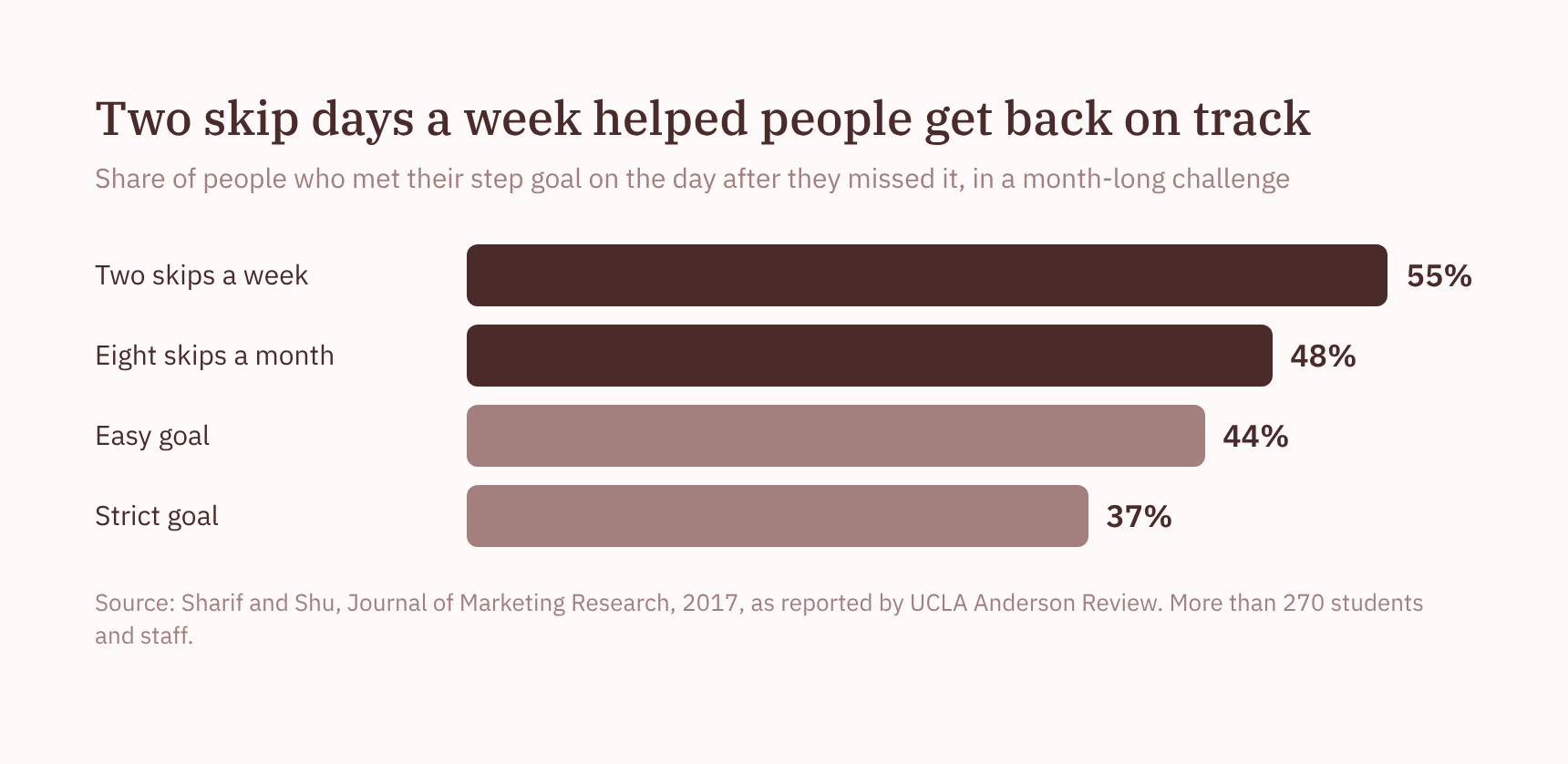
- On the other hand, a weekly count keeps each decision low-stakes. In a month-long step challenge, people given two emergency skip days a week recovered better after a miss than those with a strict daily goal.
I've tried the strict version; I once did mat Pilates with YouTube videos for more than 40 days in a row. The streak kept me going, but I don’t think I got much better at Pilates after day 10.
I’ve experienced more progress through creating a supportive environment and planning towards an outcome, such as a dance performance, than a streak-based goal.
With dance, what has always helped was knowing what to work on next. As I wrote in an earlier post, my class notes turned vague progress into a series of steps, which strengthened my motivation. So in my opinion, a streak would be a byproduct, rather than my goal.
When a professional reads your progress
I've never used PhysiApp, but came across it while reading about why home exercises are hard to keep up.
In a survey commissioned by Ohio State University, 76% of 1,006 American adults said they hadn't finished all the exercises a physiotherapist gave them. (Answers are self-reported.)
PhysiApp is the patient side of Physitrack, which physiotherapists use to set home programmes. According to its patient page, your physio builds your exercises, and the app shows each one on video and reminds you. Your physio sees your notes and can adjust the programme. It also has streaks and badges.
Researchers call this supportive accountability: support works best when the person checking in seems trustworthy, kind and knowledgeable.
It's still being tested. A review of 10 trials of digital tools in rehab, including apps, text messages and video, found they helped people keep up their exercises, though this relies on self-reported adherence.
I've done home exercises without anyone checking. What could be interesting is using my record to work towards a specific outcome. (I'd like to expand on this for dance.)
What I learnt from this
I'd first figure out what's in the way and identify prerequisite tools. Rewards raise motivation, but they can't make up for missing prerequisites like a watch, sufficient fitness or know-how.
Then, I'd define my support circle. Social visibility motivates some people but puts others off. For me, a few trusted viewers can give feedback appropriate to my level.
I'd have a purposeful plan with a clear outcome and track progress with a schedule.
Then, the most important part…
Get to practice!
- Performance: Psychologist Anders Ericsson described deliberate practice as specific goals just beyond your current ability, with feedback from someone who knows the skill.
- Enjoyment: Mihaly Csikszentmihalyi's research on flow suggests we can enjoy tasks that are just hard enough for our skill level, with a clear goal and feedback.
How Practice Book has been working for me:
- Much of the benefit comes from revisiting corrections before practice. And practice feels more productive and focused.
- I manage admin faster.
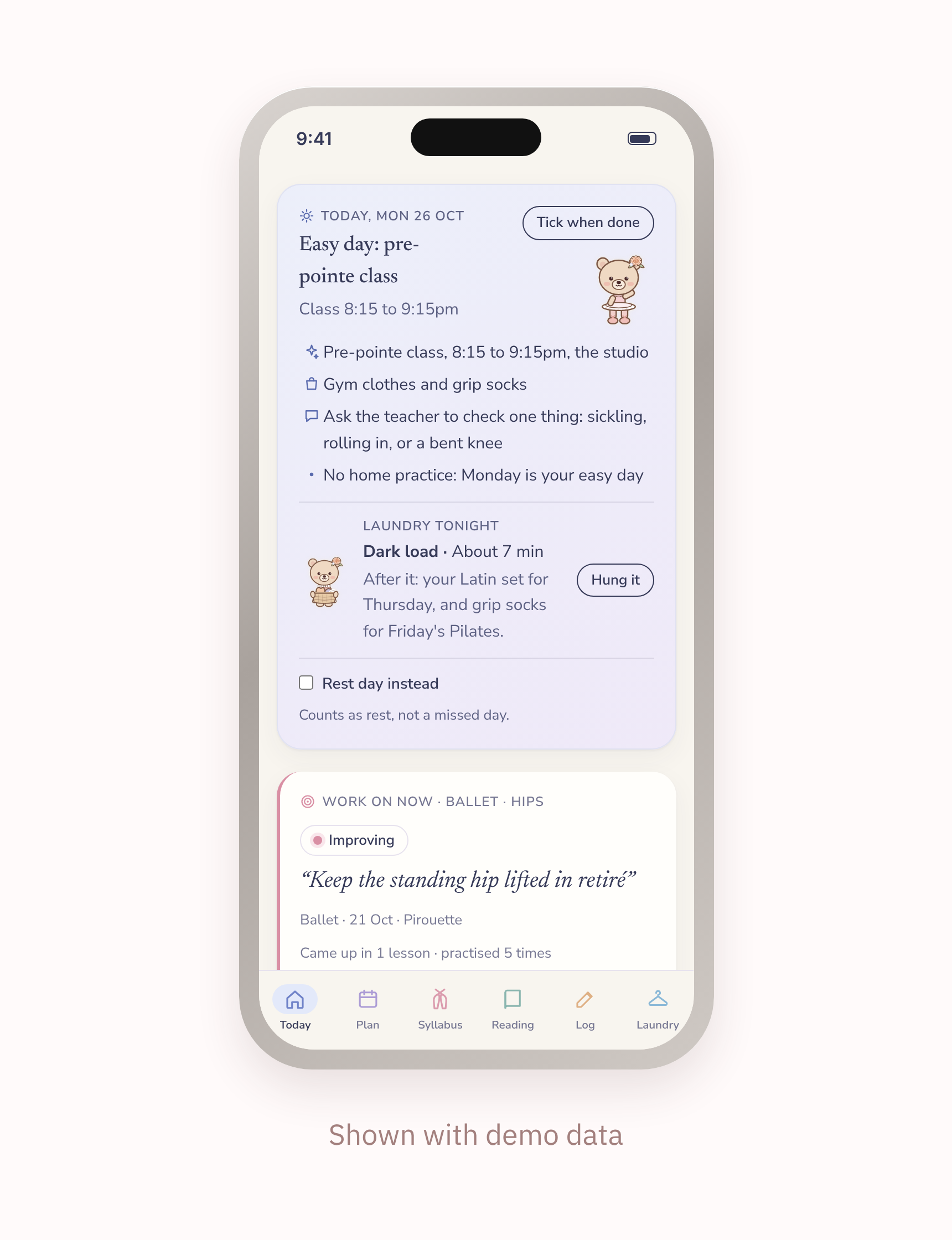
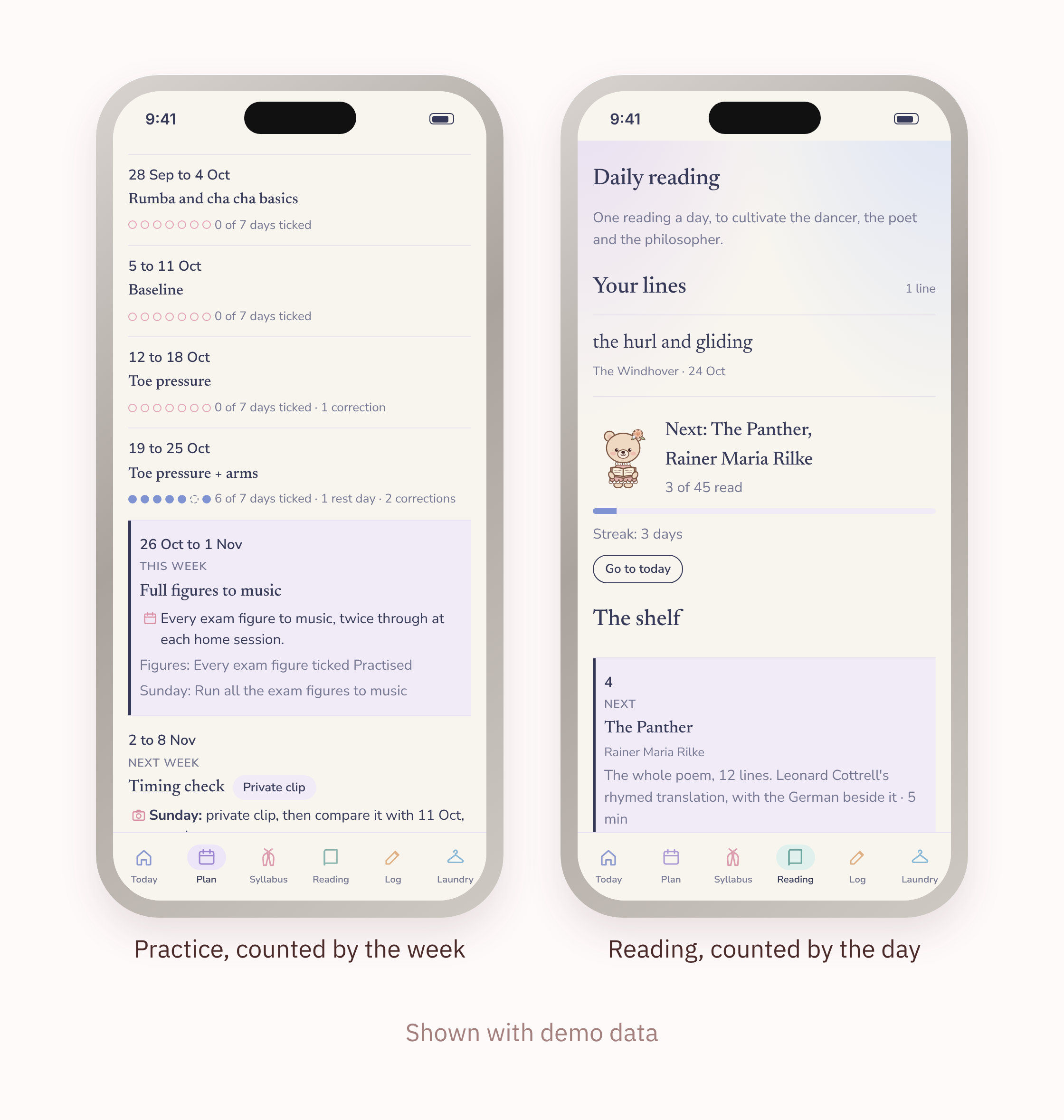
Most weekends, I spend one to two hours sorting notes and corrections so each session has a clear focus.
Cutting features
If the book started to feel like more work, I'd simplify it from a product POV.
Deciding what to leave out was easier with the Kano model, a framework for how features affect satisfaction by sorting them into:
- Basic expectations, which people only notice when they're missing;
- Performance features, where more is generally better; and
- Attractive extras, which nobody asks for but people like.
Ideally, we’d survey users to decide. With one user (me!), I surveyed myself:
- The corrections list and the daily plan are essential.
- Weekly tracking matters less; clear and timely revisions matter more.
- Rewards and streaks didn't make the list at all because my problem was not a lack of incentives.
- Attractive extras: The bear wearing different outfits.
Trying the same ideas on languages
Once the Practice Book was working, I wanted to apply the same approach to languages.
What I lacked was a daily plan, a way to bring mistakes back until they stuck, and a record of progress.
The languages differ:
- Korean and Mandarin are rusty.
- French is new. Keeping a language up and learning one from scratch call for different practice.
- I threw in English to sharpen my reasoning.
Korean is for laughing along with Korean YouTubers, Mandarin is for comfortable conversations by May 2027, and I hope to have French at B1 by 2028.
More than anything, I want to enjoy the learning and languages enough to keep going.
I tried Duolingo and stopped. It works with a combination of incentives, streaks and social sharing - I guess, like gamification?
After a while, though, the syllabus felt repetitive. I wanted to speed up when something was easy and slow down when it was hard, but I couldn't, so my progress as a self-learner felt too slow. It didn't suit how I learn.
The courses I've found most effective for me were traditional ones, where I could talk to a teacher or mentor, do the homework, and leave knowing the fundamentals.
So I prompted out a second Claude artifact, Language Desk. It's e-learning too, but I set the pace and decide what it covers.
- The Plan tab turns each goal into dated milestones I can check.
- The Today tab handles each day's practice, so I don't have to decide anything before I start, and Saturday is a rest day.
- The Review tab brings mistakes back as flashcards (I'm a big fan) until I get one right three times in a row, which counts as fixed. There's no daily streak.
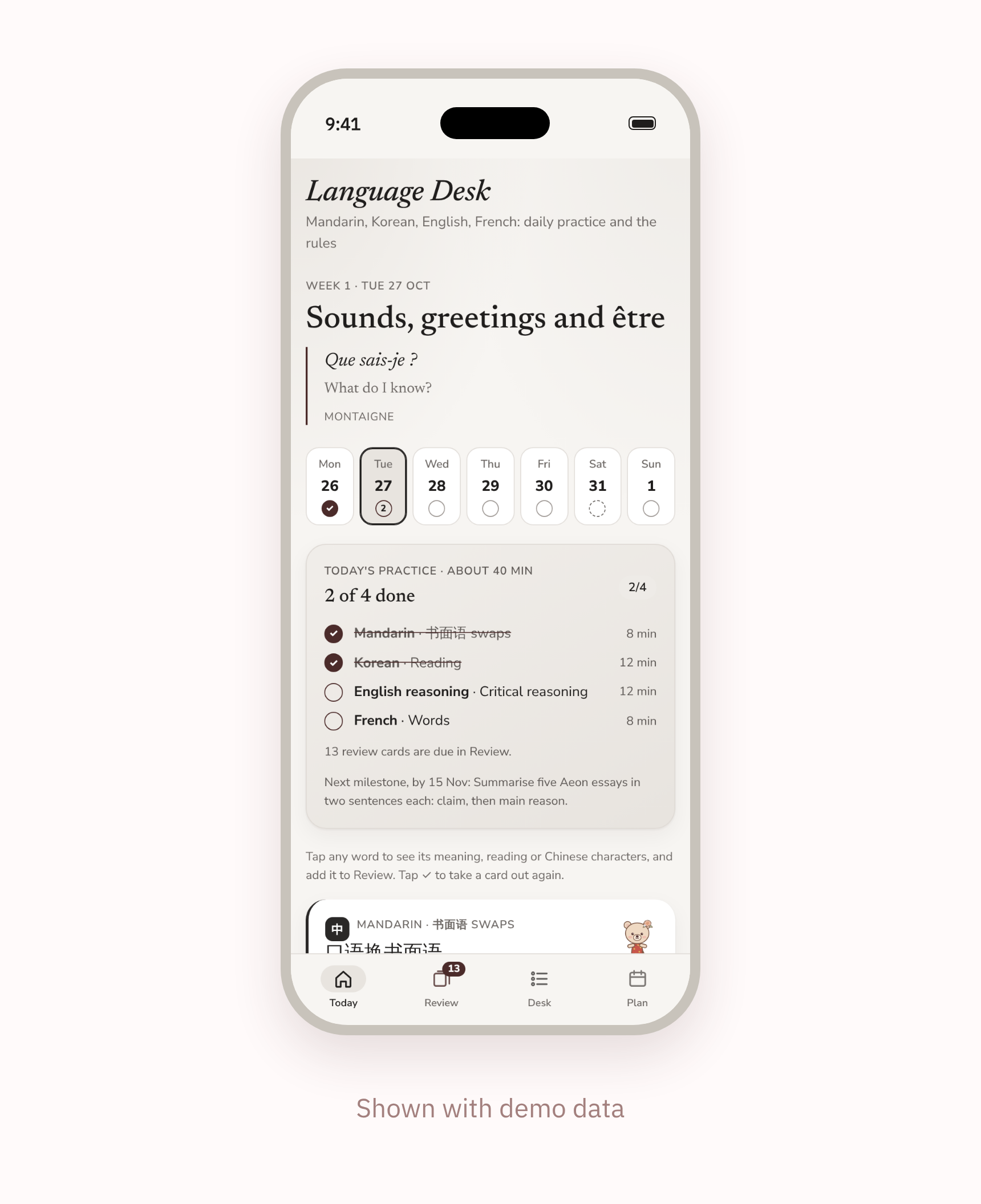
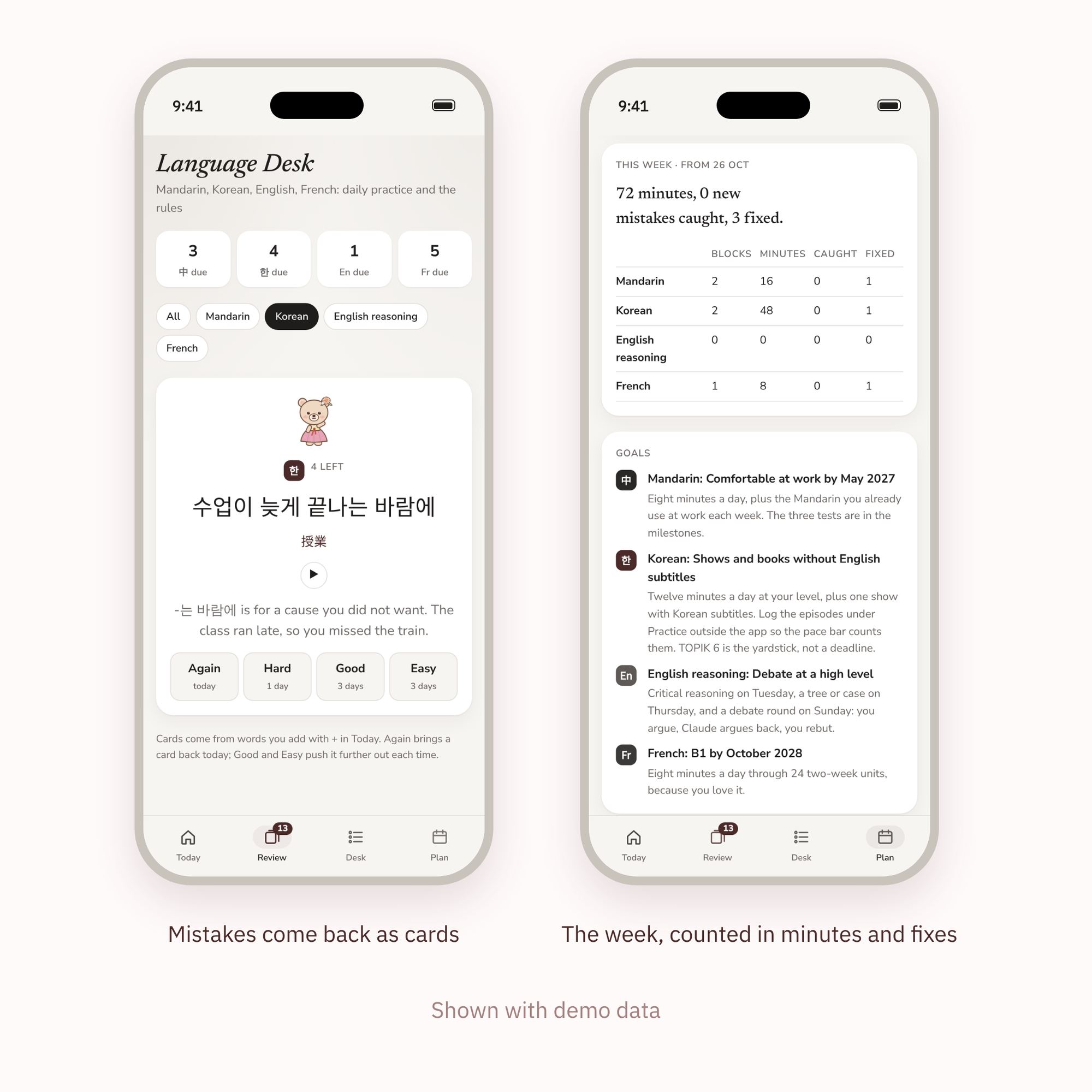
Claude marks my writing and sets a short test each month to recalibrate my level.
AI feedback has limits, but for now, I think that's enough, since French is so widely taught that I think I can still learn on my own first.
What I'll try next
While training for my Bronze Bar exam, I'd assumed that schools already do this systematically, with a syllabus, a plan, and rubrics.
Learning fundamentals gives me a shared language, a baseline to build on and a better sense of what to know.
Practice still builds tacit knowledge that reading can't, and I think it's worth learning first principles alongside it.
So what makes something stick?
- Data suits someone who'll act on it.
- Rewards suit someone who is happy to do the activity.
- An audience suits someone who likes social support.
- A professional's feedback suits someone trying to get better.
For me, organisation and useful feedback have mattered more than rewards or streaks so far.
For dance, PhysiApp's loop is closest to what I'm missing. My teachers decide what I work on, but they don't see what happens between lessons.
A one-page weekly summary for my teacher, showing what I practised and which corrections I improved on, might help.
The coach or teacher log will need some thought to make sure it's easy to understand and actually helpful.