Stumbling back into the studio: What dance practice taught me
A reflection on learning dance, and how training, volume, and intention shape the gradual progress from movement to dance.

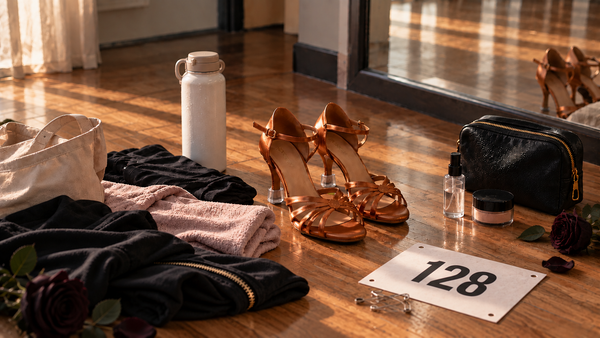
Grip socks for pilates. Slippers for ballet. Heels for ballroom. Different shoes, different demands. The same love for dance.
Stumbling into Ballroom
In April 2024, I signed up for just four Latin ballroom lessons. I started in sneakers, with no expectation of continuing.
I had energy to burn and thought it would be a simple way to move. I had always been interested in dance, but for a long time, believed it was something I had already left behind.
For some reason, this time, dance stayed with me. Since then, I have taken part in two competitions.
Here are a few lessons I have picked up along the way on practising dance. I have written them down in case they are useful, whether you are just getting started or curious about how dance training works.
1) Start with cardio
Before lessons even became serious, I had built a cardio base with one hour on the stair stepper almost daily. At that time, I didn't feel any benefits, but it was quite soothing.
Later, it became clear how important it was, as cardio gave me the stamina to attend an hour-long class, allowing me to put in the needed volume.
“You have to be fit to even do something,” my coach said.
2) Increase volume across three core categories
In short, the more lessons you take, the more practice and exposure you get, and the better you become. Everyone knows that.
I deliberately increased volume and began attending more classes.
2a) Macro-structure
While I expected to plateau and feel discouraged, I began to notice that these classes fall into three core categories.
Categorising them clarifies what each hour is designed to train, making it easier to learn, apply corrections, and see the payoff. Progress in dance is elusive and has to be felt during practice rather than understood mentally. You eventually have to learn to be aware and recognise your gains yourself.
- Foundation classes build repetition and muscle memory.
- Technique classes are highly intense, sharpening refinement with correction-based repetition. They introduce new corrections.
- Choreography classes train memory, coordination and synchronisation.
(Choreography classes are my weakest area. Defining these outcomes helped me continue despite struggling to keep up and feeling embarrassed. Additionally, performing a dance through discomfort is itself a skill that can be developed.)
A technique class might spend ten minutes drilling five seconds alone (0:55–1:00): syncopated New Yorks, ronde chasse, then a checked return into hold.
2b) Micro-moments
Short pockets of time throughout the day can be productive too, often in just under five minutes.
- Daily awareness: Paying closer attention to my body, using visualisation to refine my sternum, scapula, core, and centre of gravity.
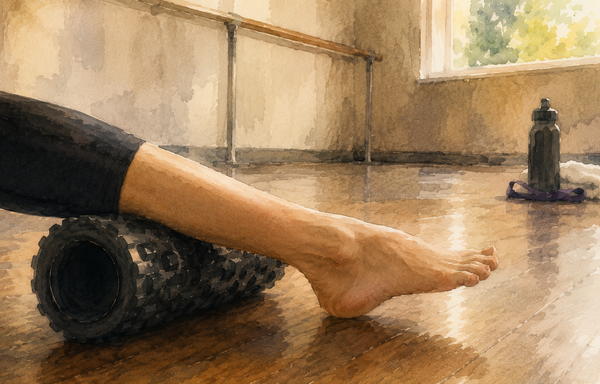
- Micro-drills: Ankle strength exercises and foot doming to build stronger arches.
- Intentional scrolling: When dance videos, especially those by Ina Jeliazkova, appeared on my feeds, I watched with focus rather than passively consuming them.
3) Write notes, review and visualise
After class, I would take five to ten minutes to think and write short notes on what was corrected and a few memory cues.
Writing these notes helped in four ways:
- Better quality of focus in class
Knowing I had to write something down made me listen more carefully. I looked out for meaningful corrections and tried to apply them immediately, while making sure I remembered them. - Stronger memory cues
Summarising the core takeaway helps me to remember the correction. Fixing one recurring mistake could take a month of conscious awareness, visualisation, and repetition. - Improve deliberate practice to internalise corrections
During the week, I reviewed videos to catch obvious mistakes and visualise the adjustment. Repeat exposure helps me absorb the change. - Stronger locus of control
Some years ago, I listened to Andrew Huberman, a neuroscientist, explain that dopamine is linked not just to pleasure, but to pursuit and progress.
The note-taking provided me a concrete progress ladder to climb, strengthening my internal motivation and positive self-talk. With something specific to work on next, progress felt directed rather than abstract, increasing my sense of agency.
4) Variety compounds growth: On cross-training
When my coach said, “The more dance styles you take, the better you get. You learn more things,” I was surprised. I assumed styles would interfere with each other. Especially ballet, where body lines and aesthetics are so specific.
But I have no lines to lose anyway (haha), so I'm open-minded. I added ballet once a week.
Ballet is calming. I also enjoy watching beautiful Vaganova adagios like these.
I also started Standard to pick up systematic figures and spatial awareness that Latin doesn’t emphasise as much.
4a) Reformer pilates improves coordination
This really moved the needle for me. In late 2024, my coach strongly recommended reformer pilates. He said it would help coordination.
While strength can be built, coordination to rhythm is harder to train. It is the unseen glue that turns movement into masterful expression.
Reformer pilates stabilised and strengthened my core, forcing controlled movement rather than compensation. The cables helped me target and engage my hip flexors, which improved my turnout and side développés.
Overall, pilates has significantly improved my strength, control, and coordination, adding polish to overall movement.
4b) Build variety, volume and performance skills at the same time by attending classes with new teachers
Dancing for a new teacher genuinely terrified me.
When I first began, I stepped out without fear because I didn’t know enough to have an ego. Somewhere along the way, the ego appears.
So, the first class with a new teacher was uncomfortable. Then it wasn’t.
The discomfort is just unfamiliarity.
Going back to the earlier lesson on volume, attending classes with a different teacher adds volume, variety and also performance exposure at once. Talk about a bundle deal!
By dancing for different teachers, you stand to gain perspective, additional insights and corrections (and encouragement) from different eyes, and a wider range of approaches.
For ballroom specifically, I highly recommend this. Physical learning is especially evident in partnered ballroom as the exchange of centre of gravity, counterbalance, and energy through the frame must be experienced in real time.
Here's another wonderful video.
I enjoy this performance because the paso doble elements are clear in both movement and musicality. The choreography aligns naturally with the Zorro theme. This shows how technique, musicality, and expression come into a coherent whole.
5) Practice performing while practising
Dance involves both practice and performance.
In one of Ina Jelíazkova's podcasts, she mentioned that when you sprint, you run as fast as your body allows. If you try to force yourself faster, you stiffen and slow down.
Dance is similar. You can only dance as well as you are capable of dancing.
Her advice was: “Practise as if you are performing.”
"Practise as if you are performing."
Rather than showiness, it’s about consistent intensity and focus from practice to performance.
So I try to keep my mind sharp, my attention fresh, put my emotions and mood aside, and bring the same performance focus into practice.
To build stamina, I sometimes crank up the volume a bit after class to condition myself to push past fatigue and maintain focus while reviewing the class corrections.
It has been nearly two years since I returned to dance. I’m looking forward to applying these learnings to my next competition or performance.
Beyond that, I’m continuing to enjoy classes, build my health, and stay present in the moments of connection and expression that dance brings.