How I used AI to study my dancing
I used screenshots, video review and ChatGPT to understand corrections, identify movement problems and build focused training plans.

I previously wrote about stumbling back into the studio. That post covered how I returned to ballroom, increased my training volume, took notes and added cross-training. I also did a serious stocktake here.
There was another part of the process I had not written much about.
I used AI, mainly ChatGPT, to study my dance videos and generate training plans.
Limits of lesson feedback
Teachers give corrections, and understanding, processing, and attentively embodying them during class are skills in themselves.
Sometimes I would hear the instruction but lack the strength, control, or awareness to apply it.
At other times, there simply was not enough lesson time to explain every detail.
Or, the correction might not even be issued. A teacher may also decide that a correction is too complex for my current level, even when I would like to understand it and begin working towards it.
Other times, a teacher can tell that something is off without being able to explain exactly what my body is doing or which supporting exercise might help.
Physical problems are not always easy to diagnose or translate for every student. That can be frustrating for both the teacher and the student, especially when the issue is visible, yet the path forward remains unclear.
Name the issue with AI
Well... Watching myself dance has been useful and horrible.
Most of us can tell when something looks awkward. Explaining why is hard.
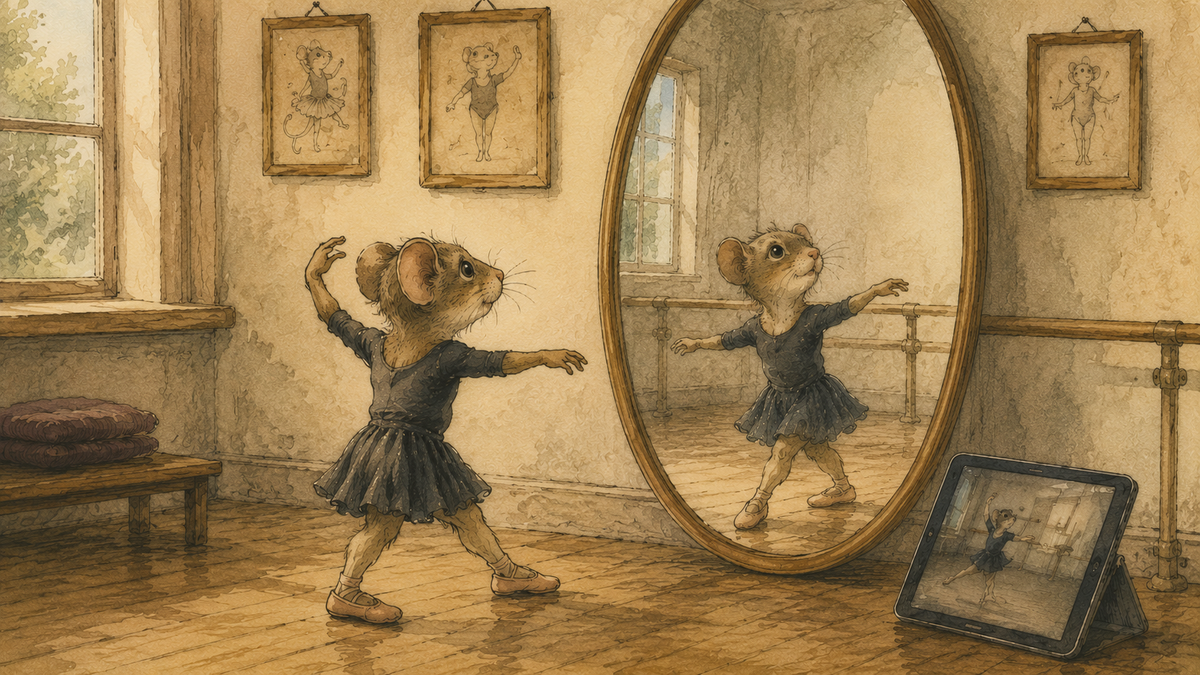
AI gave me more time to examine those details afterwards. I shared screenshots and video captures, asked follow-up questions and used the analysis to identify specific problems.
Once I could name the issue, I had something clear to practise. For example:
Move fully onto the standing foot before beginning the next action.
That gave me a clear and useful instruction to work on.
Deeper analysis with AI
I could also send screenshots of my dancing alongside those of professional dancers performing a similar action.
A professional dancer’s position comes from years of training, strength and coordination. Even after taking classes and listening to an explanation, it is still possible not to understand how a certain look is created.
AI helped me study the mechanics more closely.
- How was the standing leg organised?
- What was happening through the foot?
- What was the torso doing?
- What's different about mine? What are my weaknesses?
The comparisons helped me see the difference between the position I thought I was making and what my body was actually doing.
For example, by first using ChatGPT and then cross-checking with two instructors, I understood that my cha-cha walks were being led too much by my ribs rather than supported by pressure through the standing foot and lower body.
I had picked up the pattern while focusing heavily on rib isolations. Around that period, I also developed a mild strain that lasted for a week or two.
The problem was difficult to spot from appearance alone: Professional Latin dancers can create a strong chest-forward, hip-back shape during powerful walks.
The screenshots and analysis helped me see that their styling was still supported by pressure from the floor, organised weight transfer and controlled coordination between the rib cage and pelvis.
I was learning to separate the visible shape from the underlying strength and mechanics.
Turning observations into exercises
I can then ask AI to suggest exercises based on the issues it identified.
In one review, ChatGPT noticed that I needed more drive from my standing foot. This matched an issue that two different teachers had raised.
It also suggested that I needed better control through my ribs and core. No teacher had mentioned that yet, but the detail had bothered me whenever I watched myself dance. I could see that something was wrong, but I did not have the vocabulary to explain it or connect the pieces.
The training plan included dead bugs, slow weight-transfer drills, ankle work and balance exercises.
Dead bugs helped me move my arms and legs while keeping my trunk steady. I sometimes lost control through my ribs and core when coordinating several actions at once.
Improving that control helped me organise my weight more clearly over the supporting foot, which, in turn, supported the broader goal of generating more drive from the floor.
These exercises gave me something specific to work on outside of class. I could slow everything down, trust that the practice was contributing to my progress, and work without the pressure of keeping up.
Using AI to progress between lessons
AI helps me analyse my dancing with brutal honesty, but without too many cruel or subjective judgements.
Most importantly, it cannot replace a teacher’s judgement or experience in class (...yet?)
As my cha-cha example showed, I still cross-checked the analysis with instructors. But it is a useful complementary tool for examining a correction and working on it between lessons.
The process was roughly:
- Take a video and find the moment I wanted to understand.
- Ask what I was doing wrong and why I looked different from the reference. Compare it with a stronger example when useful.
- Work out which exercise might help close the gap.
- Decide what to look for in the next practice.
- Return to class and try again.
This helped me connect a visible problem with something physical I could train, all related to the same weakness.
Then repeat.
It is tedious, but I think it works!