Making my marks in a year of Latin dance competitions (2025–2026)
A year of Latin dance competitions and lessons from 2025 to 2026, from making the cut to working on technique, performance and confidence.

On 26 September, every judge put me through the first round of cha cha and rumba. In the semi-finals, about an hour later, I only earned one point.
I felt better in the second round, and I made no mistakes.
So I went through the score sheets, my old training plans, my blog and a year of videos to understand the marks.
I'm exactly where I'm meant to be
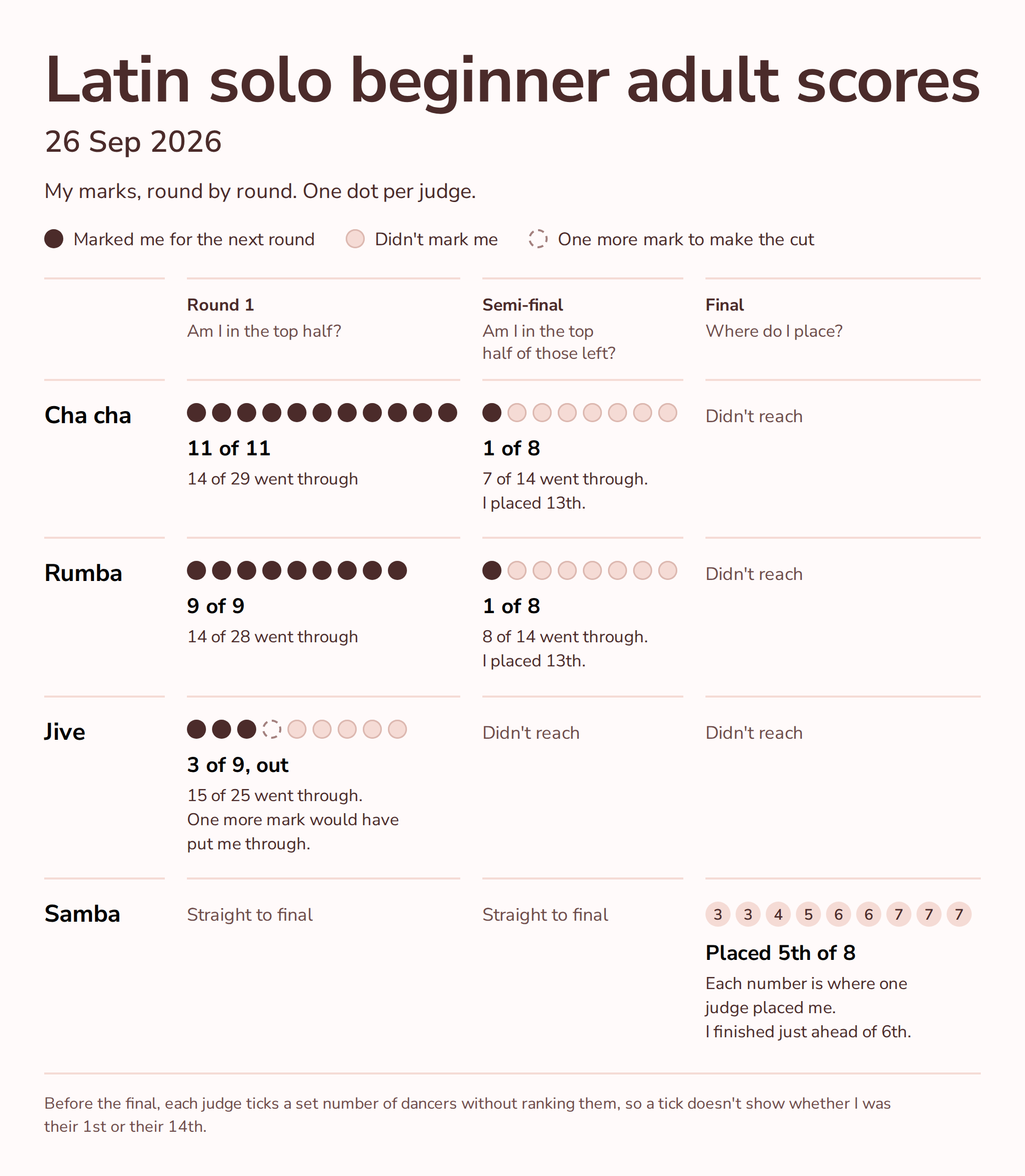
In cha cha, all 11 judges put me through round 1. In rumba, all 9 did. In the semi-finals, I received just one mark in each dance.
Round 1 isn't a ranking. There were 29 dancers in cha cha and 28 in rumba, and each judge ticked 14 to go through.
In the semi-finals, 14 dancers remained. I only finished 13th in both dances.
I felt better in the semi-finals than in round 1, and I made no mistakes. But the judges weren't comparing me with my first round. They were comparing me with the stronger dancers who had also made the semi-final.
So, I made the cut comfortably, but I wasn't yet good enough to make the final.
(Other dances: In jive, I got 3 marks and needed 4 to make the cut. I've always known jive was my weakest. My 5th place in samba was close!)
What was missing?
I don't know the exact criteria. To think through my next training plan (I don't want to waste time because YOLO, literally), I used the four judging components the World DanceSport Federation describes in its judging system overview, which I found online.
"In my 30s, I want to get the right gains from each class. Those hours might still compound into skills if I were in my teens, but now, there’s less time I’m willing to waste with passivity." Source.
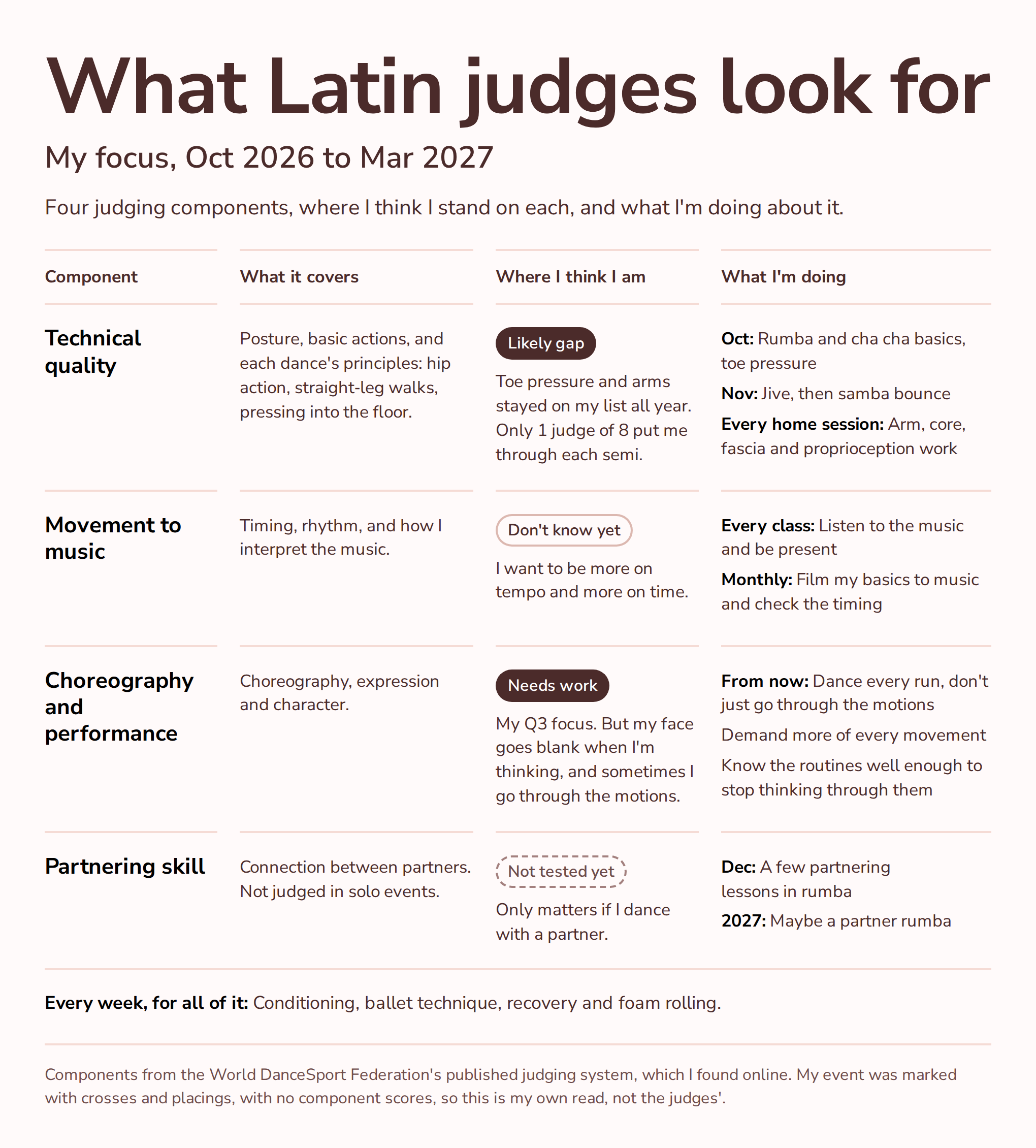
Ballet has made me more lifted. That has helped my posture and control, but Latin uses the body and the floor differently. Toe and foot pressure and cleaner arms are still on my list to work on.
My weaker dances need the most work: jive first, then cha cha and rumba. Samba was my best result.
For musicality, I want to stay more on tempo and on time, and listen to the music. That's the next step of my training.
2025 vs 2026
September 2025 was my first Latin competition. I made the cut in cha cha only, and I hadn't learnt samba or jive yet.
In 2026, I competed in all four dances. I made the semi-finals in cha cha and rumba, and placed 5th in samba.
Watching the two years side by side on video, I noticed a big change in my upper body. In 2026, my chest stays lifted, and I look sharper and more stable. I could work on lifting my head more, though.
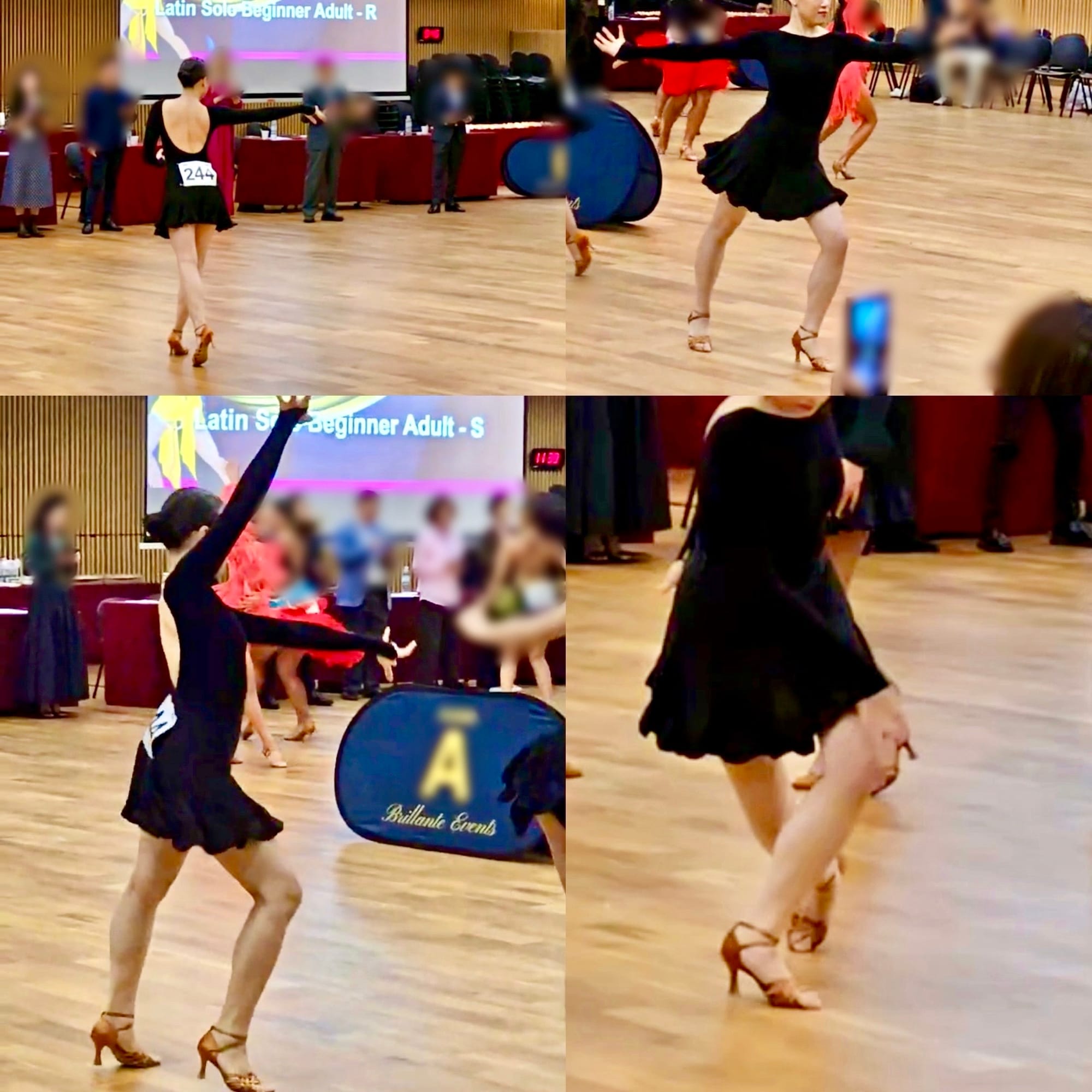
Here are my results across a year:
- September 2025: Made the cut in cha cha only.
- March 2026: 2nd at a local competition.
- April 2026: At a major international competition, I only earned 3 points. (From Noticing the water).
- September 2026: Full marks in round 1 of cha cha and rumba, and 5th in a samba final.
Generally, there has been progress.
Did the training work?
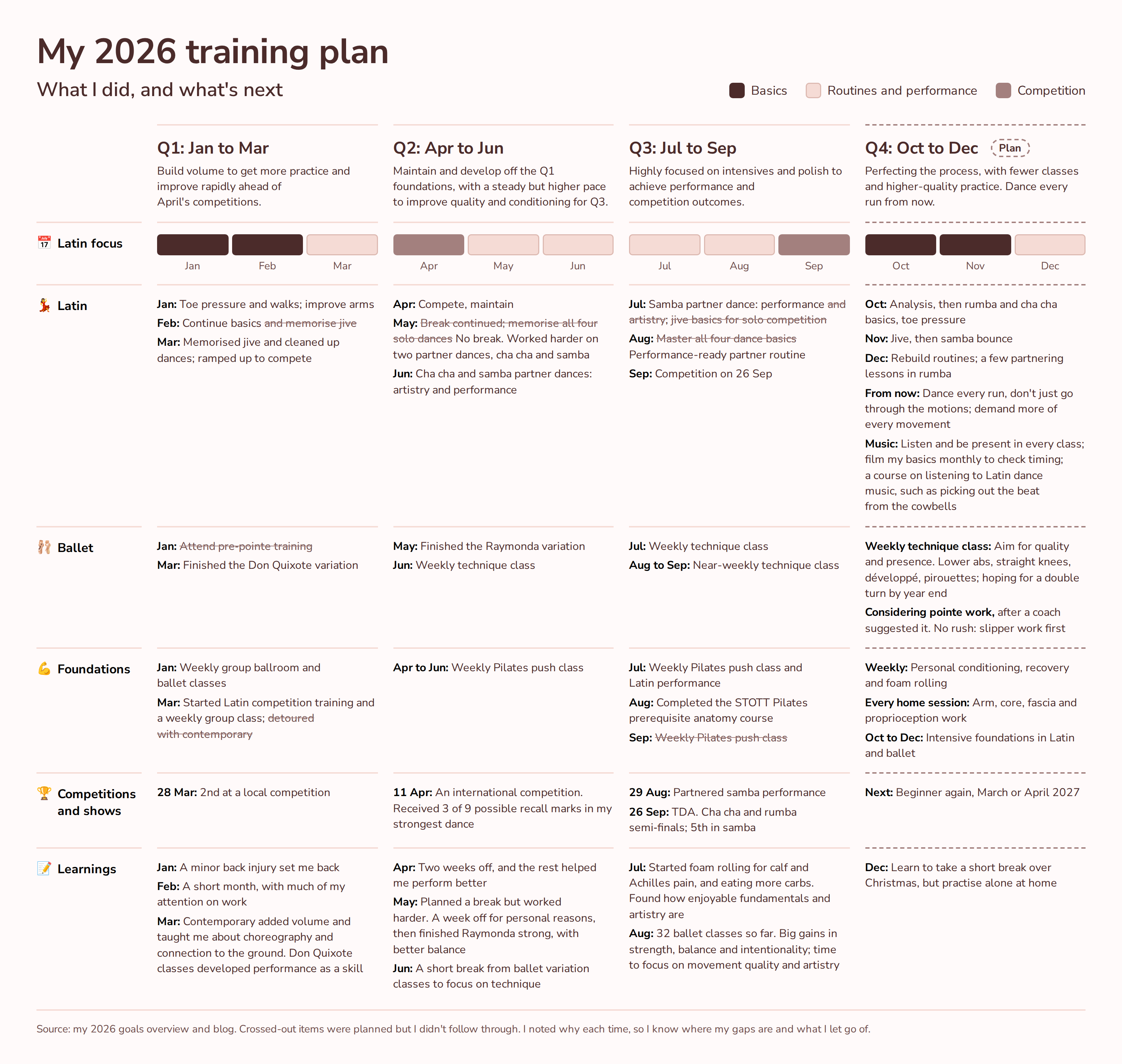
In Q1, the plan was to build volume before the April competitions. I also did ballet and Pilates.
It took a lot of mental focus to keep pushing through each week, from getting ready for class to finishing it. Mental focus and strength matter because they let me push and learn a bit more each class. Over time, that extra training adds up.
Starting in May, my Latin focus shifted to partner routines, then to performance and artistry in Q3.
What worked
- Strength and posture. After 2025, I added ballet and reformer Pilates to work on strength and coordination.
- Stamina. More cardio and more classes. By September, I felt strong. I want to keep this up, so I plan to do some fartlek training.
- Repertoire. I went from only one dance that made the cut to four dances on the floor!
- More at ease on the floor. I spent much of Q3 on performance, especially on samba. I definitely feel more comfortable performing and more expressive than a year ago.
What's taking longer
- Mental strength and courage. I'm still very stuck in my head compared with some of my younger competitors. That's something I want to work on next year: staying positive, showing good sportsmanship, and learning from the dancers around me.
- Toe pressure. It didn't improve as fast as I wanted, which shows how difficult and complex this is. I've only just started to feel the connection from my toes up to my hips, so it's still a gradual process.
- Arms. "Improve arms" was in my January plan. "Wrists still lack intention" in April. I have messy jive arms in September.
What's next
I'm starting October with analysis. I'll rewatch the competition, ask my coach what he saw, and get feedback from other dancers.
I already know some of what needs work: performance, jive and weaker aspects of rumba, toe and foot pressure, arms, and connection through my whole body.
My Q4 plan remains “perfecting the process”, with fewer classes, more self-reflection and practice, and higher-quality sessions.
Performance
Recently, I noticed that when I'm thinking while I dance, I look like I'm thinking. My face goes blank. Now, I want to execute well enough. It's not only about thinking, but thinking and doing with intention. I need to listen to the music and stay present while I dance.
Better technique will help me pay more attention to expression and performance. To get there, I want to dance every run in practice, instead of going through the motions, and demand more of every movement.
I can watch more dancer vlogs to see how dancers train, handle pressure, prepare to perform, and stay relaxed while doing something challenging.
Ballet, pointe, and conditioning
Every week, I'll keep up conditioning, ballet technique, recovery and foam rolling.
Lower abs, straight knees, développé height and pirouettes are still on the list, and I'm still aiming for a double turn by the end of the year.
A ballet coach also asked me whether I'd consider pointe work. Pre-pointe training was in my plan in January, and I let it go then because of a minor back sprain. Her question made me think about it again.
I still really enjoy slipper work, and I don't think I need to rush.
- Foundations. Good slipper work builds the foundations that pointe needs, and I'd rather dance well in slippers than force my way onto pointe.
- Priorities. Pointe shoes cost money, so there are trade-offs. I'm considering putting more of my time and resources into Latin, since I like it so much. But pointe shoes are so pretty!
Competing next year
My coach thinks I'm ready to try Open, where I'd learn more complex figures, think more about artistry and get more variety. But I'm of another mind. I'd rather finish the rung I'm on first... I think there's no harm in climbing the ladder a little longer:
- I could dance beginner once more in March or April.
- I'd like to make a jive semi-final, and a cha cha or rumba final at a big competition.
For now, I'm going to see what else I can squeeze out of myself. There's still some time to consider. I am exactly where I am meant to be, but I can always try to make my mark.
Competition is just one part of a dancer's life. There's also community, expression, artistry and new experiences. May we keep the traditions alive while leaving room to play, create and push the limits!
PS: I need to download Taobao and learn to use it. "Taobao is a dancer's friend," my coach said.
My jobs ahead
- To first pay my bills and balance my books.
- To stay calm, stay positive, and never quit what matters to me!
- To do the work in front of me with care and attention, and loosen my grip on the outcomes.
- To remember what matters: a long-term, professional mindset, quality practice, and people.
- To keep pushing my limits, learn to produce even when things are hard, recover and grow.