Starting Latin DanceSport as an adult: A guide to your first competition
How to start Latin DanceSport as an adult and prepare for your first competition, from classes and rules to costumes, rounds and what to bring.

You don't need a dance background to start Latin DanceSport as an adult. There are eight steps:
- Start dancing
- Build your base
- Decide to compete
- Enter a competition
- Prepare
- Learn how the day works
- Compete
- Review
I compete in adult beginner Latin in Singapore. I'm not a coach, so please check technical advice with your coach and always check the rules of the competition you enter.
1. Start dancing
Group classes are a relatively affordable way to learn the basic steps, meet teachers and find out whether you enjoy Latin.
You can start by learning to:
- Do the basic steps and rhythms of each dance
- Follow a short routine
- Hold basic posture
- Keep dancing for a full class
2. Build your base
Foundation classes give you repetition. Technique classes give you corrections. Choreography classes train your memory and coordination.
I have more details here on what worked for me.
- Get fit enough to dance through a full class. Cardio and strength work help.
- Practise between classes, even for a few minutes.
- Count the beats and stay focused during class.
- After class, write down your main corrections.
- Film yourself now and then. Pick one thing to fix and check it with your teacher.
- Listen to the music, not only the counts. This can be tricky at first.
3. Decide to compete
Give yourself time. Some corrections can take weeks or months. Even learning to identify the counts in the music can take time.
When you want to start competing, tell your coach:
I'd like to enter a beginner competition. What would I need to do?
Your coach can suggest an event, usually months away, which dances to enter and how much preparation you'll need.
Commitment
Expect at least one private or shared lesson a week, plus practice on your own. Lessons, entry fees, shoes and a costume will cost money.
4. Enter a competition
Once your coach suggests an event, read its rules yourself. Check:
- Category and dances: Know which category you're entering and which dances are included. Your coach should advise you on which figures are allowed.
- Registration: Check the registration and payment deadlines. Your coach will usually help you register.
- Reporting time: Know what time you need to arrive on competition day.
- Costume and shoes: Sort these out about a month in advance.
Beginner costume rules are often strict. For the beginner competitions I've entered in Singapore, a plain dress in one colour, plain tan Latin shoes and simple accessories with nothing dangly have been a safe starting point.
I would also avoid fringe, glitter, sequins, rhinestones and elaborate decorations for beginners.
5. Prepare
Work through these in order:
- Learn your routines. Memorise the full choreography first, before making every step perfect.
- Work on the details. Focus on a few corrections at a time with your coach. In technical practice, stop and redo things when you need to.
- Practise without stopping. Dance each routine all the way through, even if something goes wrong.
- Do "rounds". Dance all your competition dances one after another, take a short break, then repeat them. If possible, practise with other dancers on the floor and people watching.
Rounds prepare you for two things:
- Stamina: You may have to dance several times with only short breaks in between.
- Performance: The music may be unfamiliar, people are watching, and other dancers are moving around you. You have to find the count, adapt and keep dancing even when something goes wrong.
- Have a full-dress rehearsal. Try everything together: costume, shoes, hair and your routines. It's a good chance to break in your competition shoes and find any problems before the actual day, such as your heel catching on your dress. Practise how you'll recover and keep dancing if something like that happens.
In the last four weeks
Everyone prepares differently, but your last month could look something like this:
Four weeks before: Have your routines memorised and sort out any remaining choreography problems.
Three weeks before: Keep refining your technique and start wearing your competition shoes regularly in practice.
Two weeks before: Do at least one rounds practice, ideally with other dancers and people watching. Try on and dance in your costume.
Final week: Keep your routines familiar rather than making big last-minute changes. Check the competition schedule, pack what you need and give yourself enough time to recover.
6. How the day works
Your first competition can be confusing.
People seem to be doing different things everywhere: marking their routines in spare corners, warming up, checking a notice board, waiting beside the floor or gathering in the marshalling area before an event.
The dance floor can look confusing too. Dancers don't stand in assigned spots. They enter, spread out and find their own space to dance.
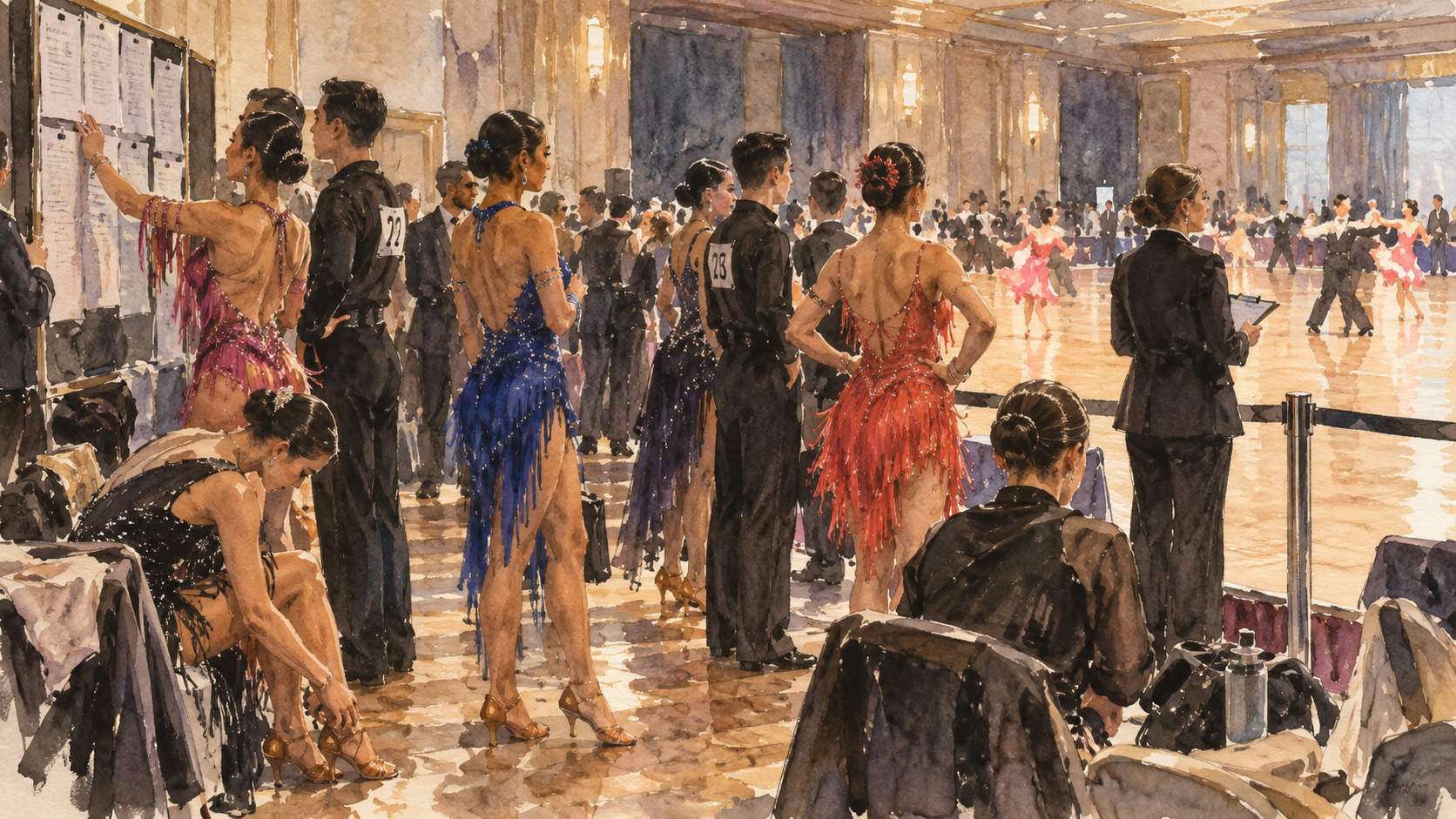
There is a system behind all of this. These are the main things to understand:
- Competition number: You'll usually wear a number so the judges know who you are.
Listen for your number before your event. When it's called, follow the marshal's instructions and join the correct line. If someone nearby misses their number, you can gently let them know. - Marshalling area: This is where dancers gather and wait before going onto the floor.
Listen for instructions and be ready when your event is called. - Event: Every dance or category has an event number. At larger competitions, the floor may be divided into separate areas, so you might see something like "Event 50, Floor A". Make sure you know your event number and floor.
- Heat: When there are many competitors, an event may be divided into smaller groups called heats.
Check which heat you're in beforehand, although sometimes groups are organised on the spot. - Entering the floor: When it's your turn, walk onto the correct floor and find a clear space.
You may see dancers do a small turn or raise their arms as they enter. Make sure your competition number is visible, settle into position and wait for the music. - Rounds and recalls: You may need to dance more than once to reach the final.
After each round, check whether you've been recalled, meaning you've been selected to dance in the next one. - Timing: Treat the printed times as a guide. Events can run faster or slower than expected, so keep an eye on the event numbers as the day progresses.
I usually stay near the floor from about five events before mine.
Once you know what all these things mean, the day becomes much easier to follow.
7. Compete
Arrive early. Give yourself enough time to register, find your way around, change, do your hair and make-up, and warm up.
Changing areas and toilets can get busy, with competitors doing their hair, make-up and grooming. You can help each other get ready!
If competition hair and make-up are new to you, practise once beforehand and check with your coach.
What to bring
- Costume and shoes
- Competitor number, tickets and anything else required by the organiser
- Bring extra safety pins for your competitor number
- Hair gel, hairspray and a comb you don't mind washing afterwards. Once your bun is secured and you've applied the gel, comb through the surface of your hair to smooth it down and get a neater finish.
- A small hairdryer, if you use one to set your hair
- Warm clothes for between rounds
- Water and food
- A massage ball or small foam roller, if you use one
Pin your competition number on securely, keeping it straight and easy for the judges to see. It's usually worn on your back. Check with the organiser or your coach if you're unsure where it should go.
I bring a massage ball to roll my calves before and between rounds. It helps loosen them up when they start feeling tense. Adult calves appreciate the extra help!
Before you dance
Warm up your body before your first round. Move your joints, get your muscles working and bring your heart rate up a little.
I also use this time to become more aware of my body. I do some planks, leg lifts, dead bugs, and work up a little sweat.
As your event approaches, stay close to the floor and keep checking the event numbers.
When you get onto the floor, dance the entire round. Mistakes happen. Recover and keep dancing.
And if you're recalled, the next round may come around quickly, so stick around.
8. Review
Before checking the results, think about your own dancing first. What went well? What mistakes do you remember? Did anything feel different?
Then look at the results. Your placing isn't only about how you danced. It also depends on who entered and what happened on the day.
If detailed marks are available, look at how close you were to progressing to the next round and go through them with your coach.
And then there's the hair. After a lot of gel and hairspray, I wash once with a cheap shampoo to get most of it out, then use a scalp scrub.
Finally, rest up!
Why I compete
I compete partly because a competition gives me something concrete to work towards, outside feedback on where I am and a reason to keep improving. It's also something completely different from my day job to think about.
Competing isn't for everyone, though. I know very good dancers who found it too stressful and chose to stop. You don't need to compete to take dancing seriously.
Most importantly, have fun and enjoy the process! :)